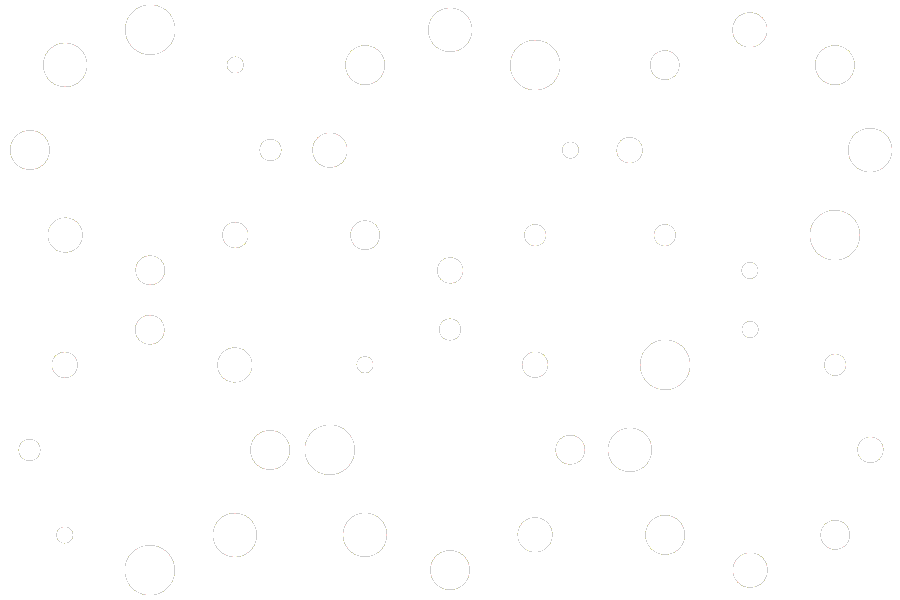
- Detailed patterns and surprising artistry within the world of spinking designs
- The Historical Roots of Repeating Patterns
- The Role of Textiles in Pattern Development
- Exploring the Geometry of Spinking
- Modern Applications and Digital Tools
- The Psychological Impact of Pattern
- Beyond Aesthetics: Spinking in Data Visualization
Detailed patterns and surprising artistry within the world of spinking designs
The art world is filled with techniques that blend precision and creativity, and among these, spinking stands out as a particularly fascinating example. It's a process that marries the discipline of pattern-making with the freedom of artistic expression, resulting in designs that are both intricate and visually arresting. This practice, while not always widely recognized by name, has a rich history and continues to evolve with the introduction of new tools and technologies. Its roots extend across diverse craft traditions, influencing areas like textile design, surface embellishment, and even digital art.
At its core, spinking involves the careful manipulation of materials to create repeating, often symmetrical, designs. The beauty lies not only in the finished product but also in the methodical process itself. It demands patience, a keen eye for detail, and an understanding of how individual elements contribute to the overall composition. It's a testament to the human desire to impose order on chaos and find aesthetic pleasure in structured repetition, reflecting a broader pattern-seeking tendency found in nature and human culture.
The Historical Roots of Repeating Patterns
The creation of intricate repeating patterns is not a modern invention; it has been a staple of human artistry for millennia. Ancient civilizations, from the Egyptians with their hieroglyphic motifs to the Romans with their elaborate mosaics, demonstrated a remarkable skill in producing visually compelling designs through repetition. These early patterns were often deeply symbolic, communicating religious beliefs, social status, or historical narratives. The precision required for these works speaks to a sophisticated understanding of geometry and design principles, even without the advanced tools available today. Furthermore, the materials used – stone, clay, textiles – significantly impacted the styles and techniques employed. The challenges presented by each medium spurred innovation and led to unique regional variations in pattern design.
The influence of cultural exchange also played a pivotal role in the development of these artistic traditions. Trade routes facilitated the spread of design motifs and techniques across continents, leading to cross-pollination and adaptation. For example, the intricate geometric patterns found in Islamic art, characterized by tessellations and arabesques, were influenced by earlier Byzantine and Persian traditions. Similarly, the floral patterns prevalent in Chinese porcelain and textiles often incorporated elements borrowed from other cultures along the Silk Road. This blending of influences resulted in a rich tapestry of designs that showcase the interconnectedness of human creativity throughout history. The enduring appeal of these historical patterns continues to inspire contemporary artists and designers today, proving that some aesthetic principles transcend time and place.
The Role of Textiles in Pattern Development
Textiles represent a particularly significant medium for the evolution of spinking-like techniques. The very nature of weaving and embroidery lends itself to the creation of repeating designs, and throughout history, different cultures have developed unique methods for embellishing fabrics with intricate patterns. From the resist-dyeing techniques of batik in Indonesia to the intricate knotting of Persian carpets, textiles offer a fertile ground for exploring the possibilities of repetition and symmetry. Moreover, the accessibility of textile materials has made it a popular medium for both professional artisans and amateur craftspeople. This widespread engagement has contributed to the diversity and innovation seen in textile pattern design across the globe.
The development of mechanized looms in the Industrial Revolution brought about significant changes in textile pattern production. While initially limiting in terms of design complexity, these machines eventually enabled the mass production of patterned fabrics, making them more affordable and accessible to a wider audience. However, the rise of digital textile printing has once again revolutionized the field, allowing for the creation of highly customized and intricate patterns with unprecedented ease and precision. This interplay between traditional techniques and modern technologies continues to shape the landscape of textile design today, preserving heritage while embracing innovation.
| Technique | Cultural Origin | Typical Materials |
|---|---|---|
| Batik | Indonesia | Wax, Cotton |
| Ikat | Various (Indonesia, South America) | Dye, Cotton/Silk |
| Kilim Weaving | Turkey/Central Asia | Wool |
| Paisley | India/Scotland | Cashmere/Silk |
The table above exemplifies a small selection of spinking-adjacent techniques. The diverse origins and materials highlight the global reach and adaptability of patterned design.
Exploring the Geometry of Spinking
Underlying many spinking designs is a strong foundation in geometry. Whether consciously applied or intuitively developed, geometric principles govern the arrangement of elements and contribute to the overall harmony of the composition. Basic shapes such as squares, triangles, and circles often serve as building blocks, repeated and transformed to create more complex patterns. Understanding these geometric relationships can provide valuable insights into the structure and aesthetic appeal of spinking creations. The application of mathematical concepts like tessellations, transformations (rotation, reflection, translation), and symmetry allows designers to create patterns that are not only visually pleasing but also intellectually stimulating.
The concept of the Golden Ratio, a mathematical proportion found frequently in nature, is also relevant to the discussion of spinking. Many artists and designers believe that incorporating the Golden Ratio into their work can enhance its aesthetic balance and appeal. While not always explicitly used, the principles of harmonious proportions often find their way into spinking designs, contributing to their sense of visual coherence. The use of grids is commonplace in initial sketching and design phase, helping to maintain precision and consistency during the pattern development process. This attention to geometrical structure speaks to a desire for order and control within the creative process.
- Symmetry is a common theme, creating balance and visual appeal.
- Tessellations, repeating shapes without gaps or overlaps, are frequently utilized.
- Geometric shapes – circles, squares, triangles – form the building blocks of many designs.
- The Golden Ratio is often subtly incorporated for enhanced aesthetic harmony.
- Grids or similar structures are commonly used as frameworks.
These elements contribute to the mathematical and artistic rigour of effective spinking work. Understanding these concepts can significantly deepen an appreciation for the intricate artistry involved.
Modern Applications and Digital Tools
While traditional spinking techniques continue to be practiced, the advent of digital tools has opened up new possibilities for design and creation. Software programs allow artists to manipulate patterns with unprecedented precision and efficiency, enabling them to experiment with complex arrangements and transformations that would be difficult or impossible to achieve by hand. Vector-based graphics programs, in particular, are well-suited for creating scalable and editable patterns. These tools offer the flexibility to seamlessly integrate spinking designs into a wide range of applications, from graphic design and illustration to fashion and interior design.
The digital realm also facilitates collaboration and the sharing of designs, connecting artists and designers from around the world. Online platforms allow for the creation of communities where individuals can exchange ideas, showcase their work, and learn from one another. This cross-cultural exchange fosters innovation and promotes the continued evolution of spinking techniques. Furthermore, the use of algorithms and generative design tools enables the creation of entirely new patterns based on predefined parameters, pushing the boundaries of what is possible with spinking. These tools can be used to generate variations on existing patterns or to create entirely novel designs, opening up exciting avenues for artistic exploration.
- Utilize vector-based graphics software for scalable designs.
- Experiment with generative design tools to create novel patterns.
- Leverage online platforms for collaboration and inspiration.
- Explore digital printing techniques for fabric and surface applications.
- Incorporate 3D modelling software for complex, layered spinking effects.
The integration of digital technology expands the possibilities for spinking, enabling both greater complexity and broader applications.
The Psychological Impact of Pattern
The human brain is inherently drawn to patterns. From infancy, we develop an ability to recognize and interpret patterns in our environment, and this ability plays a crucial role in our cognitive development. Patterns provide a sense of order and predictability, which can be comforting and reassuring. They also engage our visual system, stimulating curiosity and prompting us to explore. This innate attraction to patterns may explain why spinking designs, with their intricate repetition and symmetry, are so visually appealing. The complexity of the pattern can also be a source of fascination, challenging our perception and inviting us to discover hidden details.
Furthermore, patterns can evoke specific emotions and associations, depending on their cultural context and the colors and motifs used. For example, floral patterns are often associated with spring and renewal, while geometric patterns may convey a sense of stability and order. In some cultures, certain patterns are considered auspicious or sacred, imbued with symbolic meaning. The psychological impact of spinking is amplified by the symmetrical aspect. Symmetry represents balance and harmony, creating a sense of aesthetic satisfaction. The brain processes symmetrical images more efficiently, resulting in a more pleasurable viewing experience. The repetition within a spinking pattern can create a meditative effect, drawing the viewer into a state of focused attention.
Beyond Aesthetics: Spinking in Data Visualization
While often appreciated for its aesthetic qualities, the principles behind spinking can also be applied to solve problems in seemingly unrelated fields. One such area is data visualization. The need to represent complex information in a clear and accessible manner has led designers to explore innovative visual techniques, and patterned arrangements, reminiscent of spinking, are proving to be particularly effective. By mapping data values to different visual attributes—such as color, size, or shape—within a repeating pattern, analysts can reveal hidden trends and relationships that might otherwise remain obscure. This approach is particularly useful for visualizing high-dimensional data, where traditional chart types can become cluttered and difficult to interpret.
Consider the example of mapping genetic data. The human genome consists of billions of base pairs, and identifying patterns within this vast dataset is crucial for understanding the genetic basis of disease. By representing each base pair as a colored element within a repeating pattern, researchers can visually identify regions of the genome that share similar characteristics. This allows for faster and more intuitive data analysis, accelerating the pace of scientific discovery. The principles of spinking, with its emphasis on structured repetition and visual clarity, provide a powerful toolkit for transforming complex data into meaningful insights, demonstrating its utility beyond the realm of pure artistry and design.